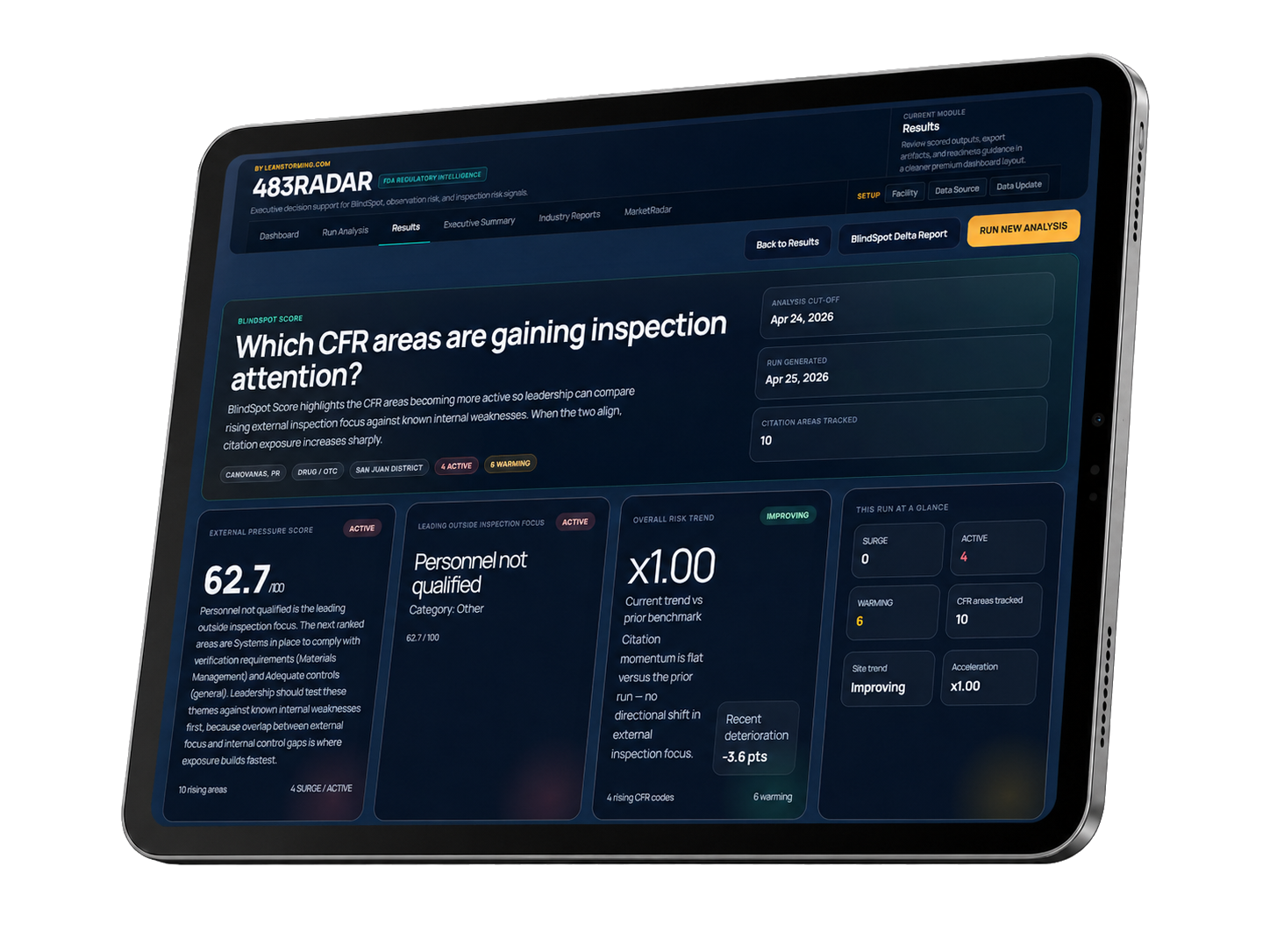
Risk Drivers
See which FDA risks are building around each site.
483Radar ties BlindSpot, observation risk, and inspection-pressure signals back to dated FDA evidence, so leaders can see what is changing before it becomes inspection exposure.
FDA Inspection Readiness Intelligence for Quality and Regulatory Teams
483Radar turns FDA Form 483 citation trends, inspection pressure, and warning letter signals into a scored facility view, a dated executive brief, and one clear first action for pharma and device quality teams.
Discovery calls are hosted by LeanStorming, the team behind 483Radar.
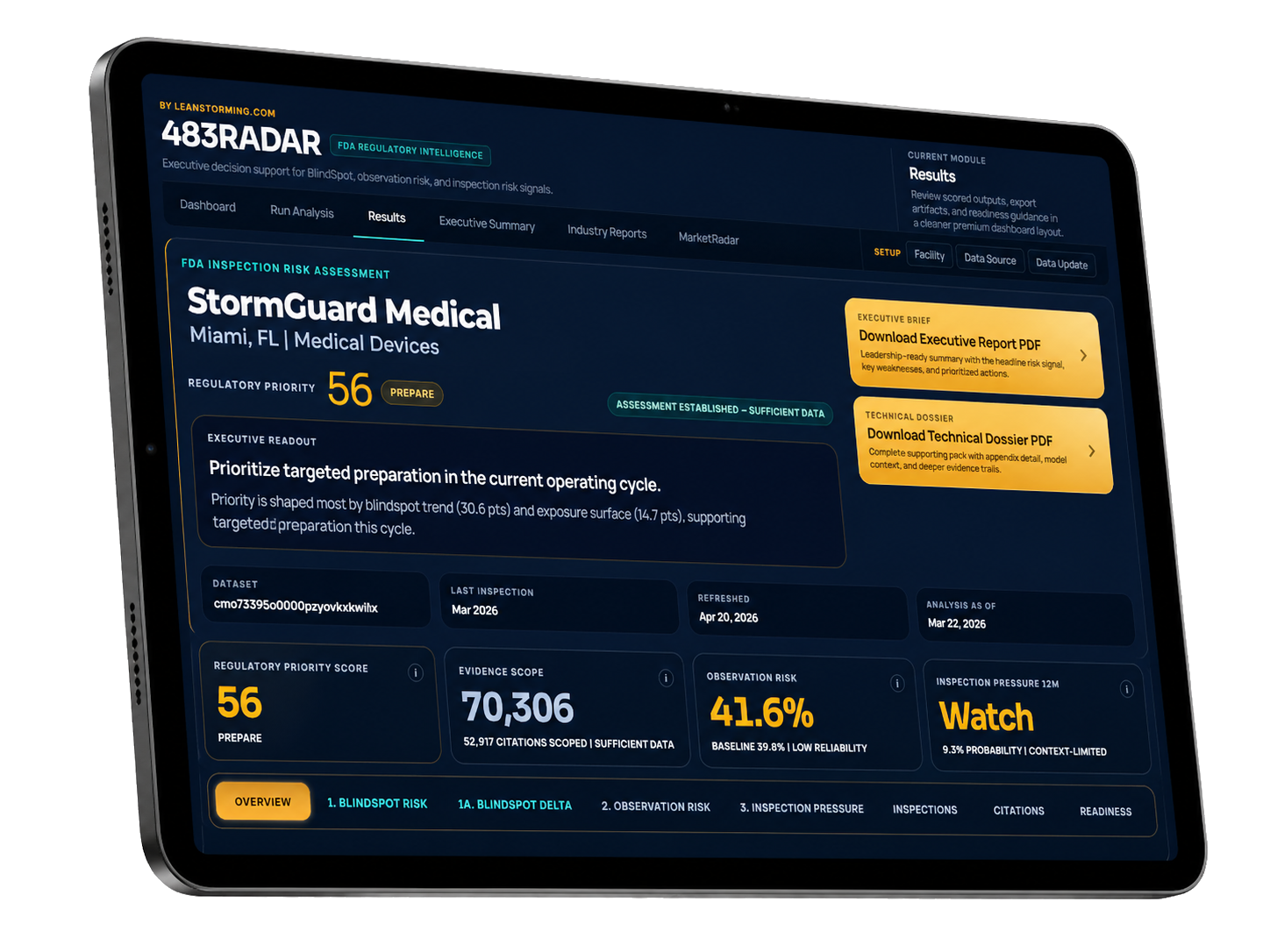
Product Journey
Scroll through the product story: the dashboard, the risk drivers, the executive brief, and the action path.
Risk Drivers
483Radar ties BlindSpot, observation risk, and inspection-pressure signals back to dated FDA evidence, so leaders can see what is changing before it becomes inspection exposure.
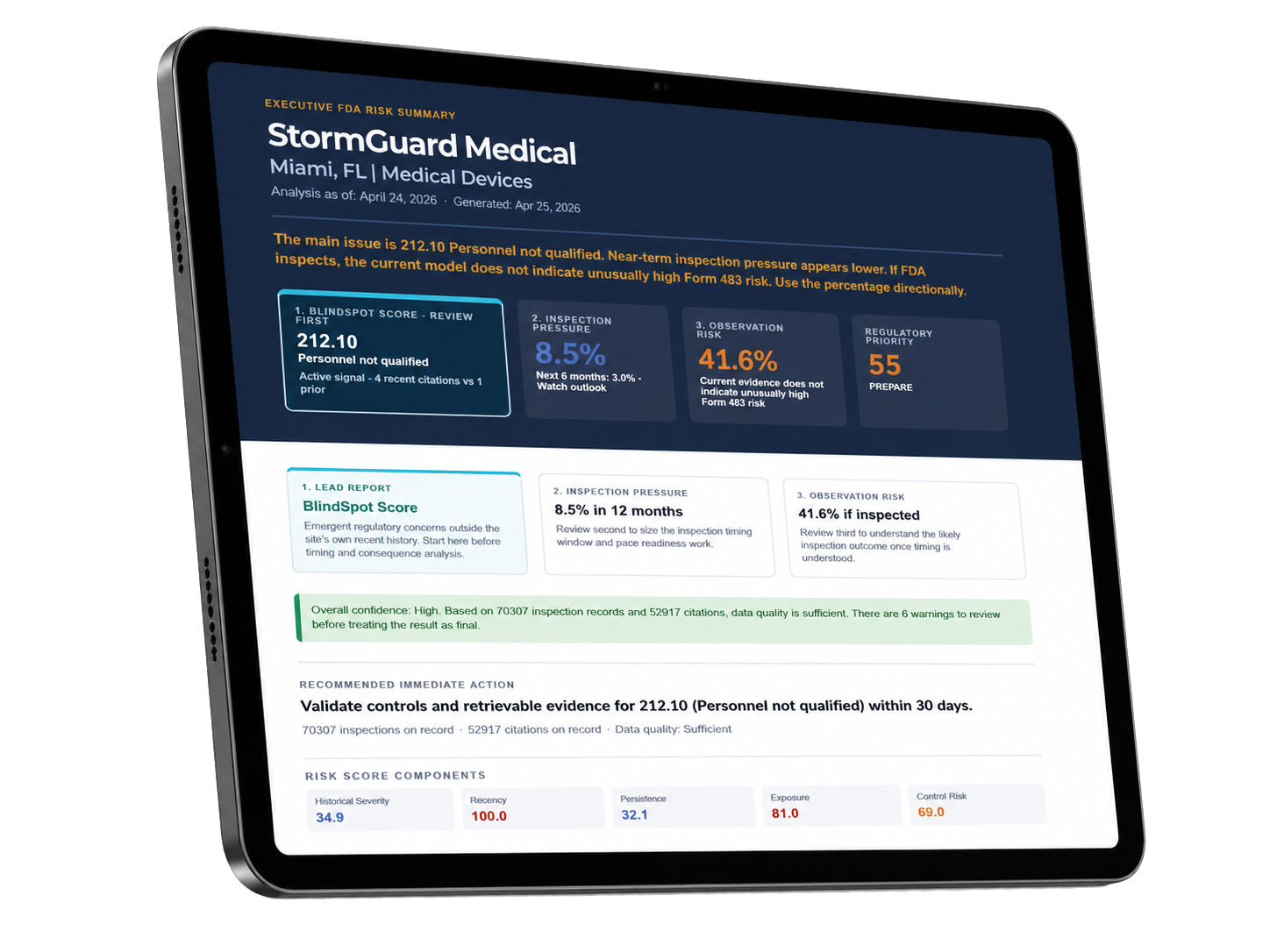
Executive Brief
483Radar turns FDA inspection data, Form 483 patterns, and citation signals into clear briefs for QA, regulatory, and operations leaders.

Action Path
The product narrows external FDA pressure into one practical decision path before the next inspection cycle tightens.
What To Do Next
Stop treating every emerging CFR signal like the same problem. In 15 minutes, narrow to the CFR domain, timing window, first review path, and sponsor-level ask that matter first.
Identify the CFR domains building fastest around facilities like yours so review starts with external evidence, not internal noise.
Assess whether that signal is likely to convert into inspection activity or elevated observation risk in the next 6 to 12 months.
Focus the review on the control gap with the highest probable exposure instead of spreading effort across every theoretical concern.
Turn the signal into a clear leadership brief with the exposure, likely cost, and immediate action worth sponsoring.
Internal Selling Power
When Quality, Operations, Finance, and leadership all see FDA risk differently, scarce resources get spread thin. 483Radar translates inspection signals into the language each function needs, so teams can align on the risks most likely to affect compliance, throughput, cost, and escalation.
Proof
483Radar is not a keyword search layer or a generic AI summary. It calculates FDA inspection risk using structured citation history, site exposure, cohort behavior, time-based inspection pressure, and reliability thresholds, then shows only the signals strong enough to support review.
BlindSpot runs nine deterministic signal families — not keyword matching. Each candidate scores across three weighted dimensions: external strength, site exposure gap, and consequence weight, multiplied by an evidence-quality confidence factor. Priority score below 0.9: suppressed. Peer cohort under six facilities: raw count signals disabled.
Observation Risk uses empirical Bayes-style shrinkage across a five-level cohort hierarchy — district × product × process down to a neutral baseline. Inspections are labeled positive only when linked citations, posted 483s, or VAI/OAI classification are present. Thin cohorts shrink toward the parent, not toward zero. Reliability resolves to one of four levels — HIGH, MODERATE, LOW, INSUFFICIENT — and governs how far the score can move from the contextual baseline.
Inspection Pressure runs a Cox proportional hazards model: 16 features, C-index 0.6815, trained on 262,129 survival episodes across 130,182 facilities. IPS-3, IPS-6, and IPS-12 are separate forecasts — not the same number at different zoom levels.
Reliability is computed per signal before the brief is assembled. A claim that fails the evidence threshold is suppressed — not footnoted, not asterisked, not softened. Gone.
Pricing
Single Facility
Review one facility now. One site. One operator. One beta brief.
Scheduling is handled through LeanStorming.com.
Final CTA
If external pressure is already forming and you are not tracking it, you are deciding late. Start with one facility in the guided beta pilot, surface the first risk, and set the first action now.
Hosted by LeanStorming with Dave Cortes.